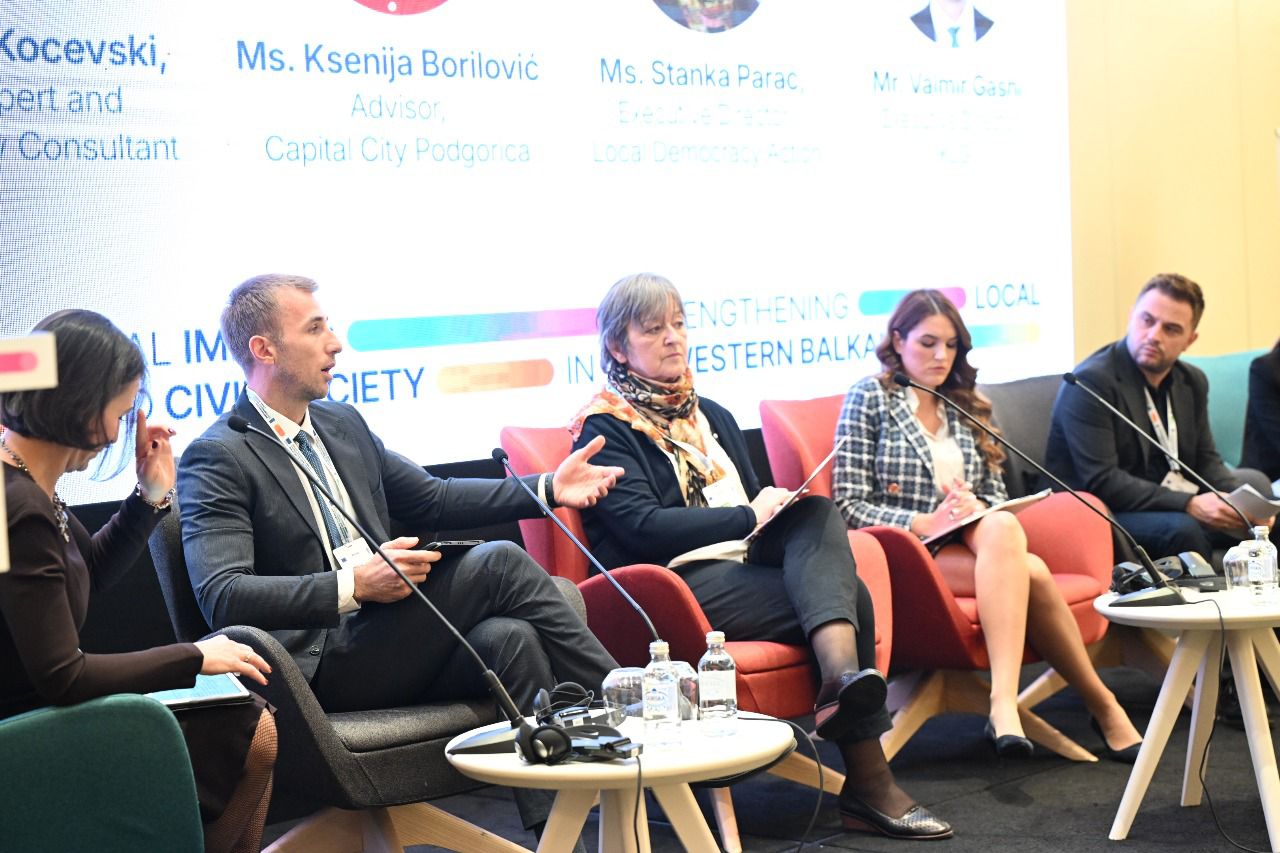
Module one / Relations between the municipal executive and legislative
Visits/meetings: Meeting with the Minister of Local Self-Government, Mr Tahir Hani and the minister’s cabinet Meeting at the Municipality of Tetovo with Ms Teuta Arifi and the chair of the municipal council, Mr Hisen…
Visits/meetings:
- Meeting with the Minister of Local Self-Government, Mr Tahir Hani and the minister’s cabinet
- Meeting at the Municipality of Tetovo with Ms Teuta Arifi and the chair of the municipal council, Mr Hisen Xhemaili
- Visit to the Municipality of Bogovinje, meeting with the Mayor, Mr Hazbi Idrizi and municipal staff
- Visit to the Municipality of Gostivar, meeting with the municipal executive
- Visit to the Municipality of Struga, meeting with the Mayor, Mr Ziadin Sela
- Visit to the State University of Tetovo (USHT), meeting with the rector, Mr Vullnet Ameti
- Visit to South East European University (SEEU), meeting with Mr Andrew Goodspeed, Vice-Rector for Academic Affairs, and Mr Agron Rustemi, Vice-Dean of the Faculty of Public Administration
Lectures:
- Presentation (Good Governance), Mr Besnik Tahiri, Master of Local Governance and International Development
- Organisation and Functioning of Local Government (the legal aspect), Mr Agron Maxhuni, Legal Director – MLGA
- Relations between the Municipal Assembly and the Mayor, Mr Besnik Tahiri, Master of Local Governance and International Development
- Inter-municipal cooperation, Mr Agron Maxhuni, Legal Director – MLGA, and Mr Besnik Tahiri, Master of Local Governance and International Development
Without the Government’s support, decentralisation fails
This was the conclusion reached at the close of the first module of the Local Governance Academy educational programme, organised by the Kosovo Local Government Institute, on the occasion of the study visit to the Republic of Macedonia.
Besnik Tahiri, the institute’s Executive Director, analysing the decentralisation process in the countries of the region, stressed that the local reform processes in Bosnia and Herzegovina, arising from the Dayton Agreement, in Kosovo, arising from President Ahtisaari’s Comprehensive Proposal, and in Macedonia, arising from the Ohrid Agreement, are at risk of failure if the Central Government’s support for Local Government continues to be lacking.
Tahiri mentioned three preconditions for decentralisation to take place: The first is a high level of central state capacity. Because effective implementation of decentralisation requires coordination between levels and more regulation to guarantee basic transparency and accountability, a weak state cannot implement decentralisation successfully.
The second requirement is a well-developed civil society. This matters not only for participation, but also because it can provide additional sources of information and feedback, as well as constructive criticism of local government.
The third is a political project in which an organised political force supports decentralisation and ensures its implementation. We should also not forget that effective local governance depends on existing resources that are adequate and sustainable.
“While we talk about decentralisation, municipalities do not have the resources to exercise their functions, which makes it difficult to provide quality services to citizens; it is therefore essential to talk about the problems and models of effective local governance,” stressed Tahiri
As part of this study visit, participants had the opportunity to meet the Minister of Local Self-Government, Mr Tahir Hani, the Mayor of Tetovo, Ms Teuta Arifi, the Mayor of Bogovinje, Mr Hazbi Idrizi, the Mayor of Struga, Mr Ziadin Sela, and the Executive of the Municipality of Gostivar.
Through these meetings, programme participants also had the opportunity to learn about relations between the municipal executive and municipal assemblies, the implementation of the decentralisation process, the functionality of municipalities and the delivery of services by municipal enterprises, and many topics related to aspects of good governance and inter-municipal cooperation were addressed.
The programme has 40 members: mayors and deputy mayors and chairpersons of municipal assemblies, while the other participants are at the level of directors and heads of assembly groups. This group of officials comes from the municipalities of Prizren, Gjilan, Klina, Kamenica, Shtërpca, Podujeva and Graçanica, and the programme also includes participants from government institutions, independent mechanisms and civil society organisations.
Meeting with the Minister of Local Self-Government of the Republic of Macedonia, Mr Tahir Hani
Opening the discussion, Minister Hani stressed that: There has always been a confrontation between local and central government. The decentralisation process in the Republic of Macedonia was carried out through the Badinter principle and is now at a stable stage of transferring competences.
Minister Hani stressed that local government accounts for 6.36% of the entire budget of the Republic of Macedonia, while one per cent (1%) of the overall budget of the Republic of Macedonia goes to balanced regional development, under the law on balanced regional development. The field of local governance is regulated by the following laws:
The Ohrid Framework Agreement; the Constitution of the Republic of Macedonia;
The Law on Territorial Organisation; the Law on Local Self-Government;
The Law on Balanced Regional Development;
The Law on the State Inspectorate for Local Self-Government;
The Law on Inter-Municipal Cooperation and
The Law on the City of Skopje
The Republic of Macedonia has 84 municipalities plus the municipality of Skopje, and 2 or 3 new municipalities are planned. Decentralisation was the pillar of the Ohrid Agreement. The municipalities have good fiscal decentralisation. In 2002, with the Ohrid Agreement, the Republic of Macedonia was divided into 80 municipalities and the City of Skopje, which comprises 9 municipalities.
Macedonia is divided into 8 regions. The smallest municipality is Vevčani, with approximately 3,000 inhabitants, while the largest centres are Skopje, with around 300,000 inhabitants, the Municipality of Kumanovo, with around 100,000, and Tetovo and Bitola. Over 25% of the population of Macedonia is Albanian.
Finally, Minister Hani stressed that the proper management of public goods is important for municipalities. If management is sound, we will have political stability; if it is not done well, a country faces destabilisation.
Meeting with the Mayor of Tetovo, Ms Teuta Arifi
In her introduction, Mayor Arifi stressed that: The Municipality of Tetovo is the second largest municipality in Macedonia and the centre of two universities. There is full political equality in Macedonia – equality in the sense of being allowed to use one’s language, culture, symbols, etc. Fiscal decentralisation is a key element of a municipality’s functioning.
Value added tax is 16% in Macedonia, but 4% is returned to the municipalities. The Municipality of Tetovo has cut municipal spending more than fourfold compared with the previous administration. Salaries were reduced from the post of mayor down to the lowest levels. By preserving the budget, municipalities can function.
The mindset and mentality of the Balkans in general is centralist and patriarchal, which is why decentralisation runs into difficulties in this region. Some Macedonian municipalities have tried to conclude agreements with Kosovo municipalities to absorb European Union funds, such as the IPA programme. However, some Kosovo municipalities have concluded duplicate agreements, which are not permitted, and as a result inter-municipal cooperation has stalled.
Tetovo has around 86,000 inhabitants, and the number of municipal councillors is determined on the basis of the number of inhabitants. The Municipality of Tetovo has 31 municipal councillors. The budget of the Municipality of Tetovo is 25 million, of which 5–6 is capital investment. Municipalities manage secondary and primary schools; programmes go through the municipal council.
Tetovo has 7 sectors, which in Kosovo are known as departments. A former head of a sector is now a candidate for president. The municipal inspectorate verifies the constitutionality of municipal decisions. Decisions in the Municipality are taken by double-majority voting.
As mayor, I decided to strengthen the sectoral team rather than the cabinet, because by placing credible people there, the sectoral policies that directly affect service delivery are best pushed forward.
Visit to the University of Tetovo, meeting with the rector, Mr Vullnet Ameti
The University of Tetovo was founded in 1994. It has 11 faculties with 47 study programmes. In 2013 it admitted 4,000 new students, and in the coming year it plans to admit 5,400 students. Social mobility happens through the university. The university plays a key role in building a society. The University of Tetovo, together with the municipality, drew up a project on preserving the biodiversity of the Sharr mountains.
During their visit to USHT, participants in the Local Governance Academy had the opportunity to see first-hand the importance of higher education in preparing a generation capable of governing better at the municipal level and at other levels too. The university also helped to raise awareness among young people of the importance of regional integration.
Visit to South East European University (SEEU), meeting with the Vice-Rector for Academic Affairs, Mr Andrew Goodspeed, and the Vice-Dean of the Faculty of Public Administration, Mr Agron Rustemi.
South East European University (SEEU) was founded in 2001 and has 5 faculties. It is accredited by the Ministry of Education of Macedonia. The university supplies its own energy, producing it from wind and sun. An additional component in this regard is its contribution to improving the profile and image of the municipality, in this case Tetovo, through education, such as preparing young people, and also by conveying the message that the municipality is interested in investing in education.
The visit to South East European University enabled participants to see first-hand how a university is managed and the importance of the curriculum and its content in relation to governance, justice, administration and other fields.
Lecture by Mr Besnik Tahiri, Master of Local Governance and International Development – “Good Governance”
Speaking about the meeting at the Ministry of Local Government in Macedonia, Tahiri stressed that we do not have a Law on Balanced Regional Development in Kosovo. Meanwhile, in Kosovo the Ministry of Local Government plays the role of referee, and it was clearly seen that municipalities have lost out because of how applications to absorb European Union funds were managed, with one municipality applying with two partners.
As for the discourse that a good mayor is one who saves money, my opinion is that you cannot be a good mayor unless you know how to invest in what generates development and well-being.
Tahiri then began his presentation on Good Governance.
Definitions and dimensions of Good Governance:
- The World Bank defines good governance as sound management of a state’s development.
- UNDP describes it as the exercise of political, economic and administrative authority to manage a country’s affairs.
- USAID links it to democratisation efforts, with a focus on human rights, public sector accountability, the rule of law, free markets, civil society, pluralism and the peaceful resolution of conflicts.
The three dimensions of Good Governance are: the State, the Private Sector and Civil Society.
- Trade unions have played a major role in democracy.
- There are two aspects of governance: technical and representative
- “Arrogance is a politician’s suicide”.
- Policies are usually decided in what is called the “Kitchen Cabinet”.
The Principles of Good Governance are:
Participation; the rule of law; transparency; responsiveness; consensus; equity and inclusiveness; effectiveness and efficiency; and accountability.
Governance is a culture. Good governance is very difficult to achieve.
Lecture by Mr Besnik Tahiri, Master of Local Governance and International Development – The Mayor: representative or dominant
Tahiri stressed that, in essence, the presentation aims to clarify the position of the institution of the mayor as a key institution in the triangle of mayor (executive) – municipal assembly (legislative) – citizen (civil society). The fundamental finding arising from KLGI’s work is that the role of the institution of the mayor in the local governance system of the Republic of Kosovo raises the need for more checks, balance and, above all, internal institutional accountability, as well as accountability to the public.
Working with municipalities, it has been seen that the very powerful role of the institution of the mayor on the one hand, and the passive role of the Municipal Assembly on the other, combined with civic apathy, results in a democratic deficit that is deeply concerning for local governance developments now and in the future.”
This situation can be explained by the lack of useful practices and clearly defined arrangements that would ensure mayors’ accountability to citizens themselves. In addition, a general democratic culture that would continually hold the mayor responsible for their duties and demand accountability is almost non-existent; after electoral cycles end, mayors can govern without regard to citizens’ preferences.
Electoral turnout and citizens’ knowledge of accountability mechanisms remain very low, and citizens show little interest in participatory decision-making processes. This is because mayors continually fail to encourage broad participation in consultative committees, and very little information is received about the results of public debates. Most municipalities have not created informal mechanisms for consulting other actors, including civil society. The development of oversight mechanisms at the public level has not been sufficiently encouraged by mayors, who control the budget for funding civil society.
Last but not least, this publication explains the mayor’s dominance as the result of a culture of passivity that pervades most assemblies (Municipal Assemblies) across the country. The lack of horizontal accountability is again a question of institutional design (arrangement). This is because the municipal assembly as an institution has no budget line, and in some cases they lack basic resources, including offices and other equipment needed to work efficiently and exercise their responsibilities. Passivity has been exacerbated by a system of party politics that puts loyalty to the party above responsiveness to citizens’ needs
Meeting with the Mayor of Bogovinje, Mr Hazbi Idrizi
Mayor Idrizi stressed that this is his fourth term as mayor. He told the participants that Bogovinje lies at an altitude of 480 metres and has around 30,000 inhabitants. In 1996 Kamenjane and Bogovinje were separated territorially from Tetovo, and in 2004 there was a new division, with Kamenjane merged with Bogovinje. “There is a positive trend with the new division of the Municipality”. Meanwhile, we have now reached the point of issuing building permits electronically.
We have established a cooperation partnership with Elbasan in an EU-funded project. As for VAT, 4.5% is returned to the municipalities, while the municipality’s other revenue comes from property tax, urban planning, the sales tax, etc. Mayor Idrizi also informed participants about developments in this municipality, the processes it has gone through since decentralisation, and the challenges it faces.
Mr Idrizi also explained that, to improve the municipal budget or increase budget revenue, taxes and fees (citizens’ obligations) to the municipality must be paid in order to improve well-being in the municipality, since what citizens pay us we in a way return to them by carrying out various projects that improve school and road infrastructure, all with the aim of citizens being satisfied with the level of services we provide to them.
Meeting with the executive of the Municipality of Gostivar
Representatives of the executive stressed that Gostivar is one of the 5 largest municipalities in Macedonia. It has around 80,000 inhabitants. It is a model of civic coexistence, of how different ethnicities should live in one place: 65% are Albanians, 19% Macedonians, and the rest are Roma, Turks and Bosniaks.
The Gostivar municipal council has 31 municipal councillors: 21 Albanians, 6 Macedonians, 2 Roma and 2 Turks. The council proposes plans, while the mayor and his administration implement them. To approve a plan, at least 16 of the municipal councillors must be in favour. The municipality has 6 sectors, 4 of which are the same as before, and it also has two public enterprises.
With the amendment of the law on regional division in 2005, 4 other municipalities were merged into the Municipality of Gostivar. With decentralisation, municipalities were given competences for urban planning (e.g. issuing building permits). Primary and secondary education was also transferred to municipal government with decentralisation. However, school infrastructure remains within the competence of the central government. Gostivar has a budget of 16,000 million euros, of which nearly 3 million are for capital investment, and it employs 122 staff.
Meeting with the Mayor of Struga, Mr Ziadin Sela
The delegation was received by the Mayor, Ziadin Sela, who at this meeting briefed them on the decentralisation process and other characteristics. Mr Besnik Tahiri expressed interest in hearing from the Mayor of Struga about the achievements and problems in the decentralisation processes.
In response to this question, the Mayor of Struga, Ziadin Sela, said:
‘’Together with taking on competences as a local government, we also inherited obligations, including debts. I am referring here to a debt taken on in 1998 by the public enterprise ‘Proaqva’’, of which we have so far paid 1 million 400 thousand euros, while the Municipality of Ohrid has not paid a single cent, and we are still paying. Meanwhile, 90 per cent of the investment was made in Ohrid and 10 per cent in Struga. In Ohrid you cannot find a single asbestos pipe, whereas in Struga you can. As a community we also face other problems, which are mentioned in the Ohrid Agreement, but that does not mean they have been resolved.
One issue provided for in the Ohrid Agreement is decision-making, which enshrines the Badinter principle; now, after 10 years, it can be seen that it does not meet this population’s need to prevent majoritarian domination. On the contrary, this principle is used to disable municipalities: even where they have an Albanian majority, they are blocked through this principle.
Decentralisation of power is another issue mentioned in the Ohrid Agreement, and one where we still continue to have problems. In reality we do not have decentralisation of power in every respect. Even if we talk about urban planning, we can issue building permits and the like, but the Ministry of Transport and Communications still has the final say.
We can open a public debate with citizens to bring in a general plan; it can be proposed in the council, pass all the filters, including through the municipality’s proposal, and be voted on. Naturally, this is done through a private company that will technically draft this plan. We will spend 1 year, we will also spend money to pay this company, and if the minister concerned remembers to, he does not approve it. It is a very difficult position for interests and for holding on to power.
We also have problems with education: we inherited schools with frozen budgets, and we again face the issue of how funds are allocated. The allocation of those funds does not match the situation we are in now. We have classes with as few as 5 pupils. In this way, 90 per cent of the funds go on salaries, because it is difficult to rationalise classes without creating social problems.
As for the budget, if 3.5 per cent of VAT were normally returned, many things would be solved, but this does not happen, and this, combined with the 2009 law on regional equality, not only fails to help regional equality but deepens inequalities by using double standards.’’
Meanwhile, summarising what had been said, Mr Besnik Tahiri stressed that ‘’The continuing tendency of degradation and the failure to channel capital investment from the centre to the municipality impoverishes society. This means that there is no political decentralisation, and no development of a municipality or region, without the support, backing and enforcement of the law by the central government, referring also to the problems with debts.
As for VAT, Mr Tahiri said that in the municipalities of Bogovinje, Tetovo and Gostivar fiscal decentralisation was spoken of with pride, because 3.5 per cent of the overall 18 per cent belongs to the municipalities. In fact, however, what happens is the same formula as in Kosovo, because VAT is collected in full at the centre but distributed according to a different criterion: it is collected on the basis of contribution but distributed proportionally. Fiscal decentralisation only makes sense if the contribution is returned to the citizen, stressed Tahiri.
The next question concerned e-permits for urban planning.
‘’The electronic permit complicated the situation for us for a while. But we have overcome it. The idea is for citizens to have more access, for the process to be more transparent, etc. It is just that we have other, more real problems. You cannot apply a system that is currently used by only 2 countries in the whole world.
Before even moving to the next phase, the cadastre is digitised too, and problems arise in obtaining certificates because the system has not yet been adapted. This situation took us about 6 months. I had just come in as mayor when, within two weeks, the law was passed for permits to be issued electronically, while not a single employee had been trained, the computers were old, etc. We were forced to buy new computers, train staff and also spend on electronic signatures, because in addition to the mayor, the signatures of other urban planning staff are also needed.
Nevertheless, we were among the first to overcome this situation, we issue permits every day, and compared with other municipalities we are among the first in the number of permits issued. So as a concept, e-permits are fine, but in practice things need more thought, because we face much bigger real problems.‘’ – explained the Mayor of Struga, Ziadin Sela.
Agron Maxhuni, Director of the Legal Department – MLGA
“The system of organisation and functioning of Municipalities”
“Inter-Municipal Cooperation”
Kosovo has 38 municipalities. Administrative boundaries have been drawn through cadastral zones. The system of self-government in Kosovo is single-tier. Municipalities have the status of a legal person. The principles of local self-government are: the principle of legality, good governance, transparency, efficiency and effectiveness, and subsidiarity.
Municipal Assemblies adopt the Municipality’s statute and municipal regulations. They also adopt the budget, investment plans, the work plan and the annual report, and may establish auxiliary bodies of the Municipal Assembly.
Mr Agron Maxhuni also spoke about the international standards adopted in domestic legislation, saying that these standards directly affect the quality of life of the citizens of Kosovo’s Municipalities. He went on to say that implementing legislation and the principles of good governance is the responsibility of the municipal bodies that emerge from local elections.
The partnership between central government, local government and specialised institutes dealing with local governance also contributes to the delivery of sustainable, quality public services to the citizens of municipalities. Mr Maxhuni concluded that this partnership contributes to building the local capacities of political and administrative structures to deliver the services that citizens themselves demand.
In his presentation, Mr Agron Maxhuni, Legal Director at the Ministry of Local Government Administration, stressed that “the current legislation offers broad opportunities in the field of IMC, both nationally and internationally (…) The fundamental principle of IMC is effectiveness and economy, while municipalities’ objectives for entering into IMC are based on will and common interest in areas such as socio-economic development, land development and use, environmental protection, and planning.”
The right to initiate inter-municipal cooperation belongs to: the Mayor, the Municipal Assembly, Citizens (at least 5% of those with the right to vote), and the Government. “The mayor must be creative”. Finally, presenting the legal regulations on inter-municipal cooperation, Mr Maxhuni stressed that municipalities are making very little use of the opportunities this law provides for service delivery.