Suhareka, a polis of its own!
An observation by the Programme Manager, Mr Besnik Muçaj, on what is being called Kosovo’s first referendum. In keeping with the spirit of the Constitution, the Republic of Kosovo recognises the right to a referendum…
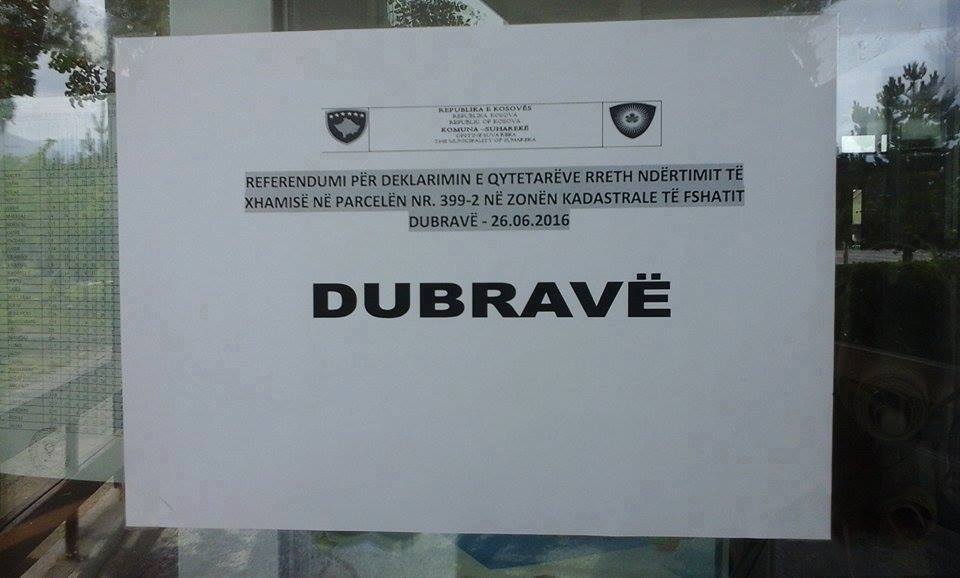
An observation by the Programme Manager, Mr Besnik Muçaj, on what is being called Kosovo’s first referendum.
In keeping with the spirit of the Constitution, the Republic of Kosovo recognises the right to a referendum, or better said a popular vote, on decisions whether general or specific. Despite the restrictions on vital issues (laws) that cannot be changed by referendum, eight years after the adoption of the Constitution citizens are still not granted the right to decide on certain issues.
Meanwhile, looked at on another scale, that of local government, it can be observed that the electoral system itself recognises each municipality as a separate electoral unit. In this light, the Law on Local Self-Government has also set the quotas (percentages) for petitions, recall of the mayor and referendums.
The Law on Local Self-Government itself, however, reveals ambiguities: in Chapter Nine (IX), on direct democracy and citizen participation mechanisms, Article 71 specifically deals with the referendum.
But the question arises: in what cases and on what issues can a referendum be organised without a law on referendums?
The Law on Local Self-Government, in Article 71, literally clarifies, defines and limits the issues that may be put to a referendum.
In the following points the article specifies:
71.1 The citizens of the Municipality may request that a regulation of the municipal assembly adopted by the municipal assembly be submitted to a referendum.
71.2 The request must be submitted to the chairperson of the municipal assembly within 30 days of the date of adoption of the regulation and must be signed by 10% of registered voters.
71.3 The municipal assembly must consider the request within 30 days of receiving the petition, in accordance with the law in force.
So, based on the Law on Local Self-Government, citizens are given the right to decide on municipal regulations according to the procedures set out. Put more plainly, citizens can decide on how local matters are regulated by following the prescribed procedures. But a referendum as such, without a dedicated law and without any administrative instruction in the field of local government, becomes completely unclear, and has in fact now opened a door that will not easily be closed.
It should be stressed that, so far, the first case put to a “referendum” is a specific issue for the residents of the village of Dubrava, with just one question concerning the construction site of a mosque proposed by the Islamic Community in that municipality. With a “for or against”, the residents took a decision, and for some the matter reached its conclusion. But whether this “referendum” is in order procedurally remains unclear.
The announcement states that the “referendum” was called by decision of the mayor, and it appears that it did not originate from citizens (10% of registered voters) and did not pass through the municipal assembly, so it is not clear what all this can be called. Bear in mind that the law expressly states that 10% of registered voters means a broad base, and compared with the number of voters this can amount to as much as 30%. Within this framework, a referendum requires a very efficient organisation, setting the electoral mechanisms in motion, in this case the Central Election Commission (CEC) as the sole authority on these matters.
But should this issue be treated as an isolated one?
I hope not, and I therefore hope for a proactive approach from the Ministry of Local Government Administration and the Government itself, fully clarifying at least these aspects: were the procedures followed? Was the law applied? And in particular, clarifying not only this issue but also those that may arise now that this path has been opened.
Besides creating ambiguity, this case is in itself an indicator of how the institutions of the Republic of Kosovo will react to such legal ambiguities or uncertainties.
The Dubrava referendum is one, but not the only, issue in which local government faces legal ambiguities and ad hoc actions by decision-makers at local level. There are many cases in which the application of the law takes on different forms and dimensions depending on interpretation.
It is high time that laws were read in only one way, in the language of the law, and applied solely on the principle of legality, that is, with strict and unconditional respect for laws and secondary legislation by all local and central actors; otherwise each municipality is a polis of its own.