
Political decentralisation is holding local economic development hostage
The Executive Director of the Kosovo Local Government Institute, Mr Besnik Tahiri, is taking part in the international conference on local self-government in the Republic of Macedonia. The conference is organised by the…
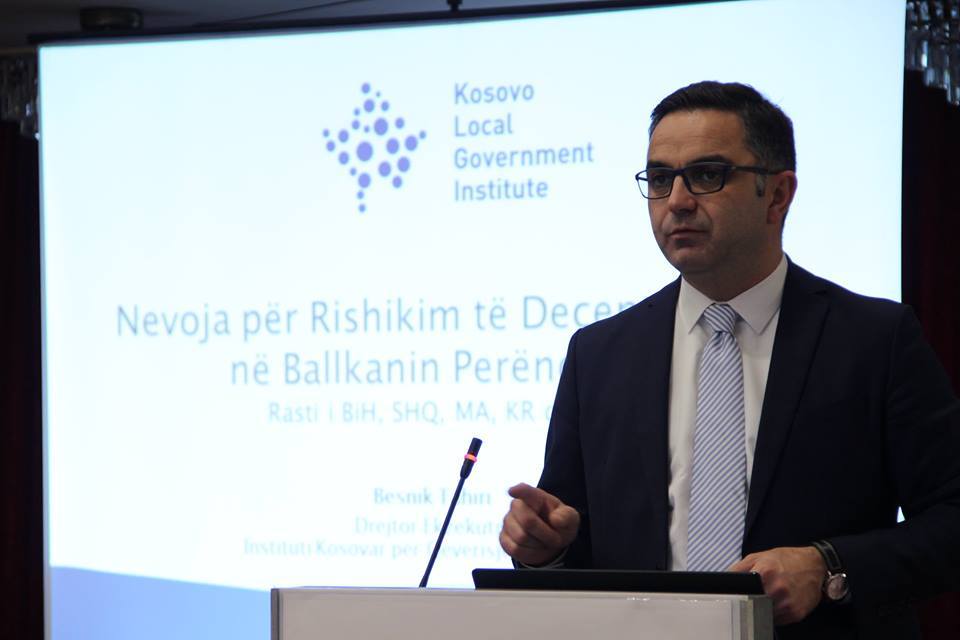
The Executive Director of the Kosovo Local Government Institute, Mr Besnik Tahiri, is taking part in the international conference on local self-government in the Republic of Macedonia. The conference is organised by the Ministry of Local Self-Government and addresses “challenges and perspectives in local and regional development – decentralisation and the EU approach”.
At this annual event, Mr Tahiri addressed the process of decentralisation and sustainable development – challenges, solutions and perspectives. Analysing the process of decentralisation in the countries of the region, he said that the process of local reform in the case of Bosnia and Herzegovina, which emerged from the Dayton agreement, that of Kosovo, which emerged from President Ahtisaari’s comprehensive package, and that of Macedonia, which emerged from the Ohrid agreement, are political processes at risk of failure if the Central Government’s support for Local Government continues to be lacking.
Speaking about sustainable development, he stressed that building the economic capacity of a local area to improve its economic future and equality of life for all is a process in which partners in the public, governmental and business sectors work together to create better conditions for economic growth and job creation. Therefore the whole development process should be balanced and integrated so as not to create fragmented areas. Otherwise, with excluded strata, the journey as a country and as a society is extremely challenging, not to say impossible.
It is therefore clear that in order to have strong and efficient local governance it is important to pay particular attention to strategic planning and economic development, so that in the long term only those municipalities that can carry out strategic planning and manage to generate local economic development will be able to offer a wide range of services and also to improve the performance of their administration, and vice versa.
It is therefore essential that throughout the region there be a functional review of decentralisation, carried out systematically, sector by sector and functional area by functional area. Otherwise the municipal and national government entities will continue to operate in the dark, leading to confusion, paralysing initiatives, weakening services and lowering the level of transparency and accountability of both levels of government.