
Public administration reform requires active efforts from all actors
Within the framework of the LGA – Empower programme, the KLGI Institute held the second meeting of the thematic group “Administration and Reform”. In this session, through professional facilitation, participants…
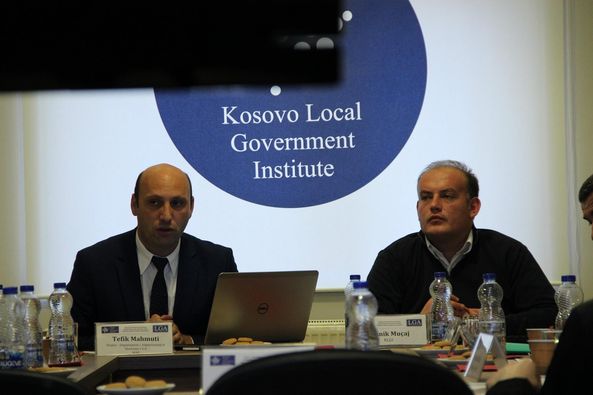
Within the framework of the LGA – Empower programme, the KLGI Institute held the second meeting of the thematic group “Administration and Reform”. In this session, through professional facilitation, participants discussed the processes and challenges facing public administration reform at the local level.
At the outset it was noted that basic laws are being challenged by mechanisms and legal provisions produced by sectoral laws with regard to municipal administration and services. On this basis, if we look at education, we find three control mechanisms: the labour inspectorate, the independent oversight board and the education inspectorate. These mechanisms have often challenged municipalities with contradictory decisions in particular cases concerning employees in the education sector. This is just one dimension showing that municipalities are continuously challenged by legal ambiguities.
Although the job catalogue has created an overview of the positions and duties of civil servants, there is a lack of clarity regarding the treatment of the entire body of employees at the local level, such as political staff, support staff and specific sectors (education, health). Therefore, there is a need to complete the legal basis in an umbrella law, which should be the law on public administration. This law would clearly categorise employees in the administration, making the oversight and reform process even clearer.
Although there has been progress in building a clear standard covering recruitment, duties, functions and evaluation, it must be stressed that a clear, well-organised and fully standardised process still requires major efforts from all actors. If we look at the level of standardisation of jobs, we can say that there is still a lack of clarity regarding specific functions, such as chief financial officers, internal auditors or support staff, as to where and at what grade they should be categorised. This is largely a consequence of ad hoc actions by municipalities and sectoral institutions.
It is important to stress that a clear categorisation and definition of who is a civil servant and who belongs to other categories would greatly reduce the perception of overstaffing in the administration, whether at the local or central level. People often speak of an administration of 80 thousand employees. If we look at the categorisation under the law on the civil service, this number is around 18–23 thousand. A clear distinction must be made between the overall body of employees in institutions and civil servants.
Despite these facts, the process is encouraging. This is in view, first, of the European target standards and, second, of the positive initiatives of institutions in the reform process. Reform as a concept and process requires continuity and energy; nevertheless, some first steps have been taken. It is extremely important that, alongside the reform, evaluation mechanisms, whether internal or external, are increased. Measuring citizens’ satisfaction with services is fundamental. To this end, it appears that citizens will soon have the opportunity to contribute to improving processes and services through advanced forms of evaluation.
To make administrative work clearer, there is a need for a standardised map of procedures and responsibilities of institutional mechanisms at all levels. In this regard, a transparent and merit-based recruitment process also requires professional and sustainable mechanisms, as part of the effort towards professionalism, higher service quality and greater citizen trust in the administration.
This programme is supported by the Royal Norwegian Embassy in Kosovo.