Administrative reform, the main condition for EU integration
As part of the first module, participants in the LGA-VI programme, on a special visit, had the opportunity to meet the Minister of Innovation and Public Administration, Ms Milena Harito. The purpose of this visit was to…
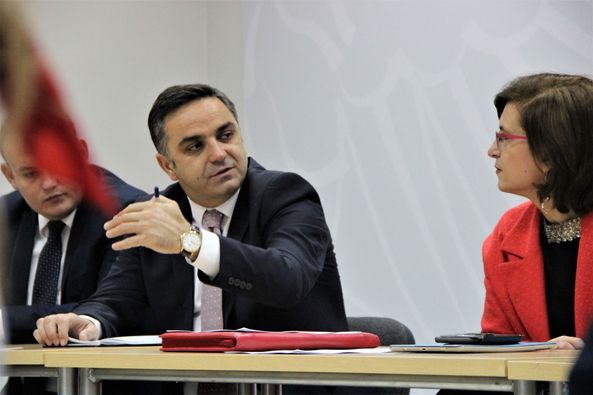
As part of the first module, participants in the LGA-VI programme, on a special visit, had the opportunity to meet the Minister of Innovation and Public Administration, Ms Milena Harito. The purpose of this visit was to learn about the efforts the Ministry of Innovation and Administration is making in building the capacities of the public administration; integrated public services through the ADISA agency; and innovation in administration
First, the Executive Director of the KLGI Institute, Mr Besnik Tahiri, spoke about the need for cooperation and for adopting good practices from Albania in the integration process of both countries. On this occasion, Mr Tahiri opened the discussion by stressing that in developed countries good governance is no longer a matter of debate, for two reasons: first, because it has become the norm and the culture; and second, because there is advanced oversight and accountability, where the consequences of any deviation are clear.
Therefore, the very notion of functional and efficient decentralisation is linked to the process of delivering fast services. The digitalisation of services has changed the very dimensions and concepts of decentralisation. In other words, the key to success is innovation in the exercise and delivery of services.
Minister Harito and her team thanked the KLGI Institute for the visit and expressed their willingness to cooperate further by sharing experience during the reform process in Kosovo. On this occasion, they presented to participants the Ministry’s vision and political commitment to the reform process, the steps taken to raise standards of public service delivery, and the Ministry’s efforts and portfolio in the integration process.
At the meeting, the Minister and her team spoke about the reform process as a necessity and one of the five key conditions for opening accession negotiations. It was stressed on this occasion that in all assessments this area has made the greatest progress.
It was also stressed that administrative reform cannot be pushed forward without taking into account three key elements: legislation, human resources and digitalisation. Presenting the legislative reforms, Minister Harito stressed that good legislation provides for standardised processes and procedures, avoiding debates and divergent interpretations of procedures and documentation by the state administration. In other words, “the state must have one face”, where every civil servant must interpret clear and precise procedures.
As regards increasing administrative capacity, the Minister pointed out that the number of officials trained by the School of Public Administration (ASPA) has increased eightfold. Nevertheless, these capacities are still insufficient to meet European standards.
On digitalisation, she spoke of an investment of 100 million dollars over the last three years. These funds have mainly been invested in advanced programmes and the integration of services, eliminating unclear and complicated procedures and processes. The delivery of integrated public services (ADISA) is currently being tested as a pilot. This followed a detailed assessment and the assignment of unique codes to 1,400 services.
So, despite the progress, there is still much work to be done in advancing the mindset of the administration, in which everyone is there to serve the public. This must be achieved by making it clear that service delivery is mandatory and subject to monitoring.
Participants had the opportunity to see at first hand the premises, the model and the work of the School of Public Administration (ASPA), where it was clearly evident that full professional, technical and operational capacities exist for advancing the capacities of the state administration.