Service delivery is not a matter of debate, but of standards and procedure
The sixth generation of the LGA programme held sessions and working visits as part of its first module (democratisation and decentralisation). The LGA programme aims to integrate lectures with working visits to…
The sixth generation of the LGA programme held sessions and working visits as part of its first module (democratisation and decentralisation). The LGA programme aims to integrate lectures with working visits to institutions that exercise these functions in practice. Linking the academic and normative part with the context significantly increases the quality of professional education.
In this vein, the lecture sessions covered: Decentralisation from a historical, academic and research perspective – the International Context of Local Governance and the Development of Local Government; Basic Concepts of Decentralisation: Devolution, Deconcentration and Administrative Decentralisation – Rondinelli’s Principles; Democratisation in relation to Decentralisation – the Case of Kosovo.
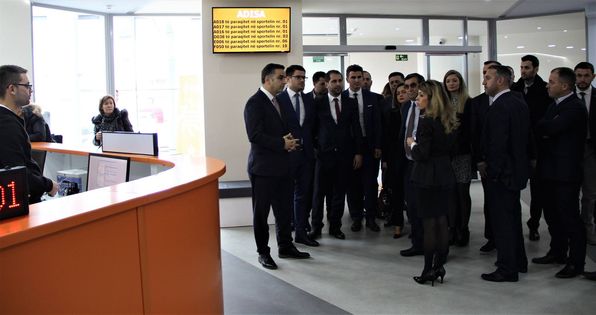
Meanwhile, through a working visit, participants saw the link between decentralisation and the deconcentration of integrated public services within the Agency for the Delivery of Integrated Public Services (ADISA) in Kavaja, Republic of Albania. The visit aimed to inform participants about advanced models of delivering public services to citizens.
ADISA was established in response to the need of Albania’s citizens for efficient, high-quality and transparent public services. Its mission is to deliver public services by setting up and administering reception counters for citizens (front office) and integrated one-stop-shop public service centres for services provided by central government institutions and agencies and/or local government units in accordance with the legislation in force or relevant agreements.
To this end, throughout its work in delivering the modules, the LGA uses three models:
o Flow: the LGA sequences learning practices so that participants learn from past experience and move on to a deeper and broader understanding of problems;
o Continuity: after covering the topics, the LGA programme deals in practice with specific problems and then draws up a logical map that serves as a tool for addressing these topics and problems at local level;
o Integration: through integration, the LGA encourages and promotes improved learning beyond the boundaries of the programme.
The LGA thus uses a series of learning methods and practices to support participants in achieving the training outcomes. These experiences are mainly activity-based, with the aim of also enabling them to apply theory in practice. The activities are designed, sequenced and grouped in a way that helps participants achieve results.
The LGA is supported by the Norwegian Embassy.