Municipalities, a sustainable foundation for security
Security at local level is a key platform for community life and for the development of the private sector and investment. As part of the educational programme “Local Governance Academy”, the Kosovo Local Government…
Security at local level is a key platform for community life and for the development of the private sector and investment.
As part of the educational programme “Local Governance Academy”, the Kosovo Local Government Institute held its fourth module, in which three separate sessions dealt with aspects of security at local level. The module’s work examined aspects of security ranging from community policing and the emergency plan to the role of municipalities in reducing the risk of extremism.
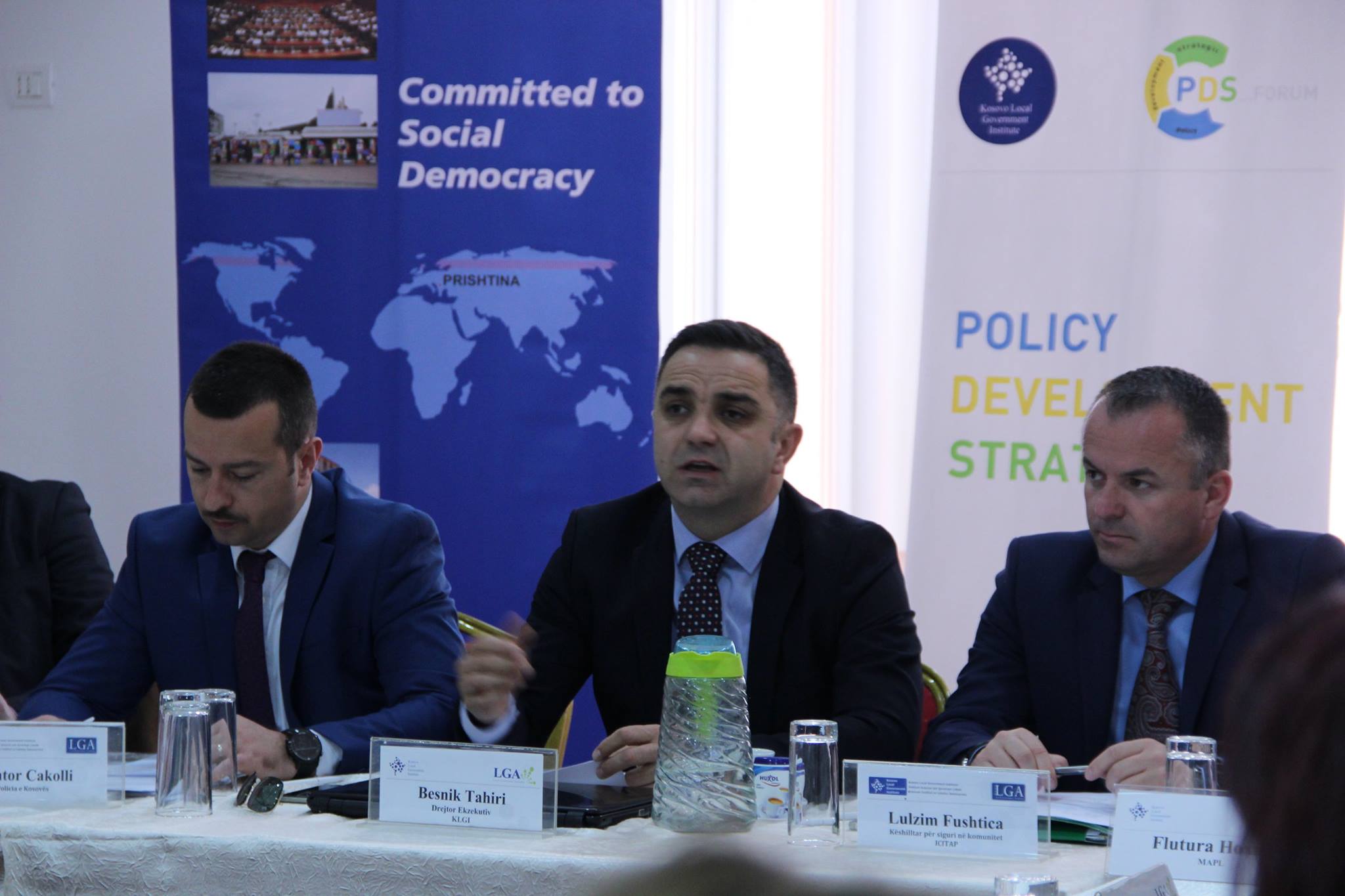
Opening the session, the Executive Director of the KLGI Institute, Mr Besnik Tahiri, stressed that security at local level is a sustainable foundation for community life and for the development of the private sector and investment. Municipalities should therefore further strengthen coordination and cooperation mechanisms with the police and local communities in order to provide a sustainable platform not only for security but also for intervention in emergencies.
This is because such situations, besides revealing the problems residents face, also show the lack of an action plan to eliminate the critical points that in an emergency can become a great danger to citizens’ lives. The institutions’ duties do not end when the crisis passes; rather, that is the key moment for drawing up a serious emergency plan, repairing damage and coordinating with central institutions and local communities.
Mr Lulzim Fushtica, community safety adviser at ICITAP, stressed that coordination with municipalities aims to work towards a common goal, increasing mutual respect and trust and building strong foundations from which shared issues and concerns can be addressed to solve local problems.
The desired outcome of this community interaction is reduced crime, improved living conditions and community safety. To this end, the MCSCs, made up of representatives of NGOs, the media, education and the police, act as a coordinating council on the issues citizens face and on bringing them to the responsible institutions, with the aim of identifying and addressing issues related to crime, safety and quality of life, in order to achieve the common goal of creating a safer community.
In his lecture, Mr Mentor Cakolli of the Kosovo Police addressed the philosophical and practical aspects of implementing the Community Policing Strategy and Action Plan 2012–2016. The presentation explained in detail how the concept of community policing extends across the vertical and horizontal levels of police organisation, the elements of the community policing concept (organisational transformation, building partnership with the community and problem solving), police sector division and the community safety infrastructure, with particular emphasis on establishing or making functional the Local Public Safety Committees.
Community safety has been defined as a proactive approach to identifying and solving problems in the community, aimed at reducing fear of crime, raising the quality of life through improved safety, changing perceptions of safety and encouraging reporting, that is, mutual cooperation between the police and citizens.
Recommendations from the working sessions:
The recommendations entail cooperation and coordination of activities between the municipal and central levels. Challenges remain in vertical and horizontal communication, the sustainability of projects, raising the awareness of municipal officials and the community of the existence and activities of community safety forums, and the implementation of central-level strategies at municipal level.
The concept of community policing and raising community safety in general is not solely the task of the Kosovo Police; this approach must be embraced and actively implemented by all municipalities, institutions, NGOs and citizens in general;
Budget lines should be allocated for implementing community policing activities in order to build a culture of reporting and responsibility among citizens in general and to advance a proactive police approach to the various incidents that may occur in the community;
Municipal assemblies should support the initiatives of police officers assigned to police sectors to promote the concept of community policing and to make known the police officers who look after citizens’ safety;
Municipal assemblies should support the awareness-raising and cooperation initiatives of the Local Public Safety Committees (LPSC) in order to increase community safety in municipalities.
The role of municipalities in preventing extremism is very important, and this role is also set out in the activities foreseen by the strategy and action plan for the prevention of violent extremism and radicalisation leading to terrorism 2015–2020.
Cooperation with local safety forums (MCSC, LPSC, CSAT) in municipalities, the religious community, NGOs and civil society through meetings to identify the problems and concerns that push people towards radicalisation and extremism;
Kosovo has also joined the global initiative supported by the US Department of State, the Strong Cities Network, which aims to share municipal-level experience in preventing extremism. Membership of this initiative would make it possible to benefit from projects and donations in this field;
Making functional, together with municipalities, the referral mechanisms (and Standard Operating Procedures) for reporting and handling suspected cases of radicalisation and violent extremism. The Referral Mechanisms will serve the early identification of individuals at risk of, or vulnerable to, radicalisation and violent extremism, thereby preventing the further radicalisation of individuals in our society;
The municipal level and the safety forums should share responsibility and cooperate with the Kosovo Police, and organise regular meetings between public institutions and the community, schools and religious communities, using existing networks and mechanisms.
This programme is supported by the German Friedrich Ebert Stiftung foundation.