Public policies push authorities to rationalise governance actions
Within the framework of the project “An effort towards sustainable and functional local governance”, the KLGI Institute is holding its first module, on “Supporting municipalities in advancing public policies”, in the…
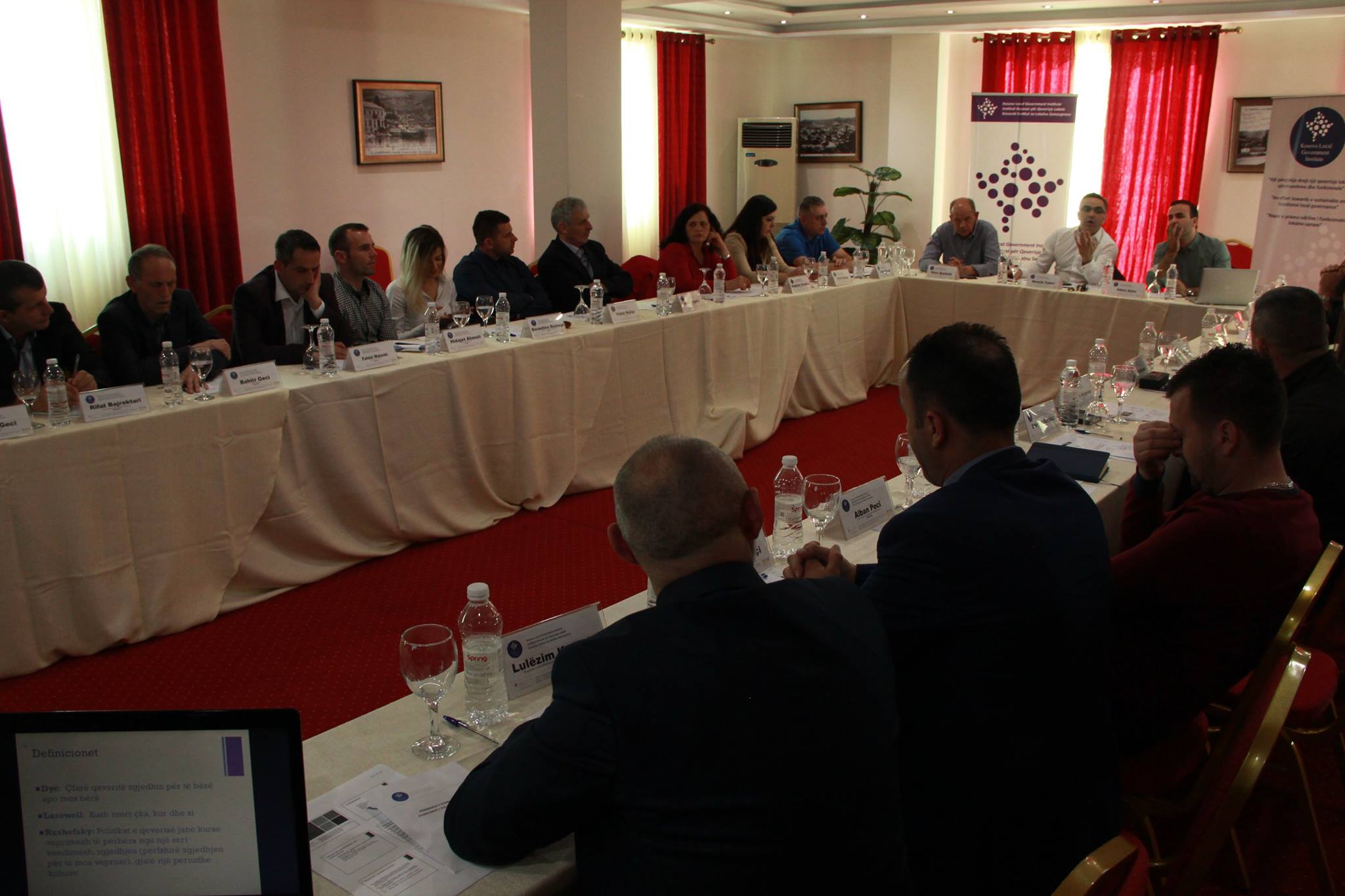
Within the framework of the project “An effort towards sustainable and functional local governance”, the KLGI Institute is holding its first module, on “Supporting municipalities in advancing public policies”, in the Republic of Albania.
The first training session will initially serve to familiarise participants with the programme and will at the same time address the drafting and implementation of public policies. In this context, this modular training aims to train participants in different contexts of public policy, their role in the democratic level of governance and the areas of action or inaction.
The session stressed that public policies are closely linked to the rationalisation of public action, while the evaluation of public policies aims to determine to what extent a public policy has achieved its set objectives and produced the impacts expected by the public.
The lecturer in this module is Mr Adem Beha, Professor of Public Policy at the University of Prishtina, who is addressing the lack of capacity to tackle complex issues through concrete policies in Kosovo. Therefore, in the policy-making process it is important to understand the relationships of interaction between actors, interest groups and external experts, as well as their conflicts of interest.
The monitoring and evaluation component is just as important as the planning and justification of a programme. During assessment and evaluation, or rather during analysis, the following should be borne in mind: aspects, goals and methods. Assessment and evaluation analysis requires explanation, not description, and argumentation about causes and consequences.
Another extremely important aspect of implementation is formats and systems, so as to avoid the fragmentation of policies and finances. An Integrated Planning System (IPS) should therefore represent a set of operational principles that ensures the planning and monitoring of government policies as a whole are carried out in the most effective and harmonised way possible.
Mr Besnik Tahiri, for his part, is addressing the role of public policies as a very important component of society. In this respect, decision-making is an important element, since it is a product of policy-making and affects the lives of individuals directly and continuously.
For this reason, governing authorities, recognised as the first-hand actors, have an important role in the decision-making process; in other words, to govern means to make public policy. The government’s resources are always the same: legislative power, control over public finances, information and the media.
Participants in this module are municipal directors and managers from all regions of the Republic of Kosovo.
“This grant is funded by the Democratic Society Promotion (DSP) project – funded by the Swiss Cooperation Office in Kosovo (SCO-K) and the Ministry of Foreign Affairs of Denmark (DANIDA) and managed by the Kosovar Civil Society Foundation (KCSF)”.