The democratisation of municipalities passes directly through communication and the media
Within the framework of the “Local Governance Academy (LGA)” programme, the KLGI Institute held its third module on “The role of the media in the democratisation of municipalities”, which analysed strategic…
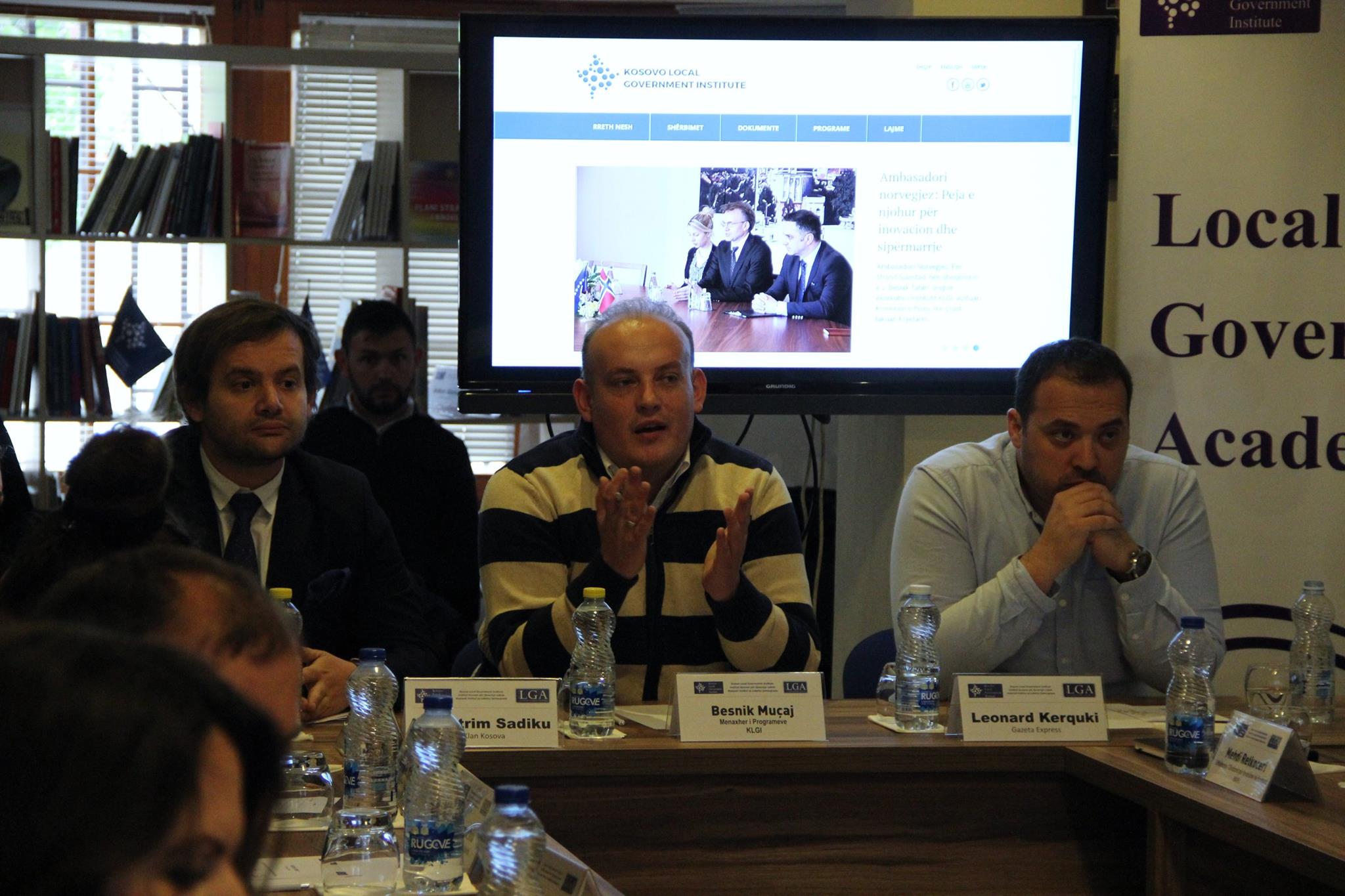
Within the framework of the “Local Governance Academy (LGA)” programme, the KLGI Institute held its third module on “The role of the media in the democratisation of municipalities”, which analysed strategic communication and the role of the media in the democratisation of municipalities, electronic media and the role of social media in increasing transparency and accountability.
The lecturers in this session were Mr Kushtrim Sadiku, journalist at Klan Kosova; Mr Leonard Kërquki, editor-in-chief of Gazeta Express; and Mr Arben Ahmeti, journalist at RTV Dukagjini. The topics addressed aimed to convey the importance of the role of the media and good practices in municipalities’ approach to communicating with the media, news portals and social media.
On this basis: “The everyday way of governing”; How seriously are issues dealt with?; How does governance look to citizens?; What are the working environments like?; How do we put out information?; How do the media reflect it?; Where do we want to see ourselves? – all of this is a summary of strategic communication. Every working day, every action, how they perform, how services are delivered, how we speak informally – this is the concept that is built up among the public. In other words, we are what others see us as. Communication is therefore not simply a task, but a strategy.
The communication policies of local authorities depend directly on their strategies and actions, first in internal communication and then in communication with other actors. Information sharing reduces bureaucracy for citizens, modernises work processes and enriches the formulation, implementation and evaluation of policies. New information and communication technologies offer ways of enriching and improving communication and the flow of information.
Providing citizens with information about priorities, programmes and activities increases the likelihood that a public authority will be seen as legitimate by citizens and interest groups, contributing to the strengthening of local policies. It also helps elected officials and the administration make informed decisions.
Communication demands often pull government institutions in opposite directions. On the one hand, municipalities must act impartially in order to preserve credibility and meet expectations of transparency and accountability. On the other hand, institutions must act as advocates for their own policies. The main challenge for effective communication turns out to be trustworthiness and credibility while advocating policies in a contested communication environment. These were the key topics addressed in an open and proactive discussion.
Among other things, it was emphasised that municipal information offices have basic problems, ranging from communication and monitoring to a non-proactive approach. Consequently, it is essential to set a standard for all municipalities regarding how information office teams operate, and to consider concrete steps towards strategies that set out priorities for increasing transparency, accountability and participation.
It was stressed that municipalities’ synergistic efforts to strengthen local development should be increased. On this basis, it is assumed that their input in solving local problems will carry more weight if there is effective communication. Exchanging views, ideas and experiences at the local level can bring the right expertise and, at the same time, full understanding, engagement and support.
The overall conclusion was that the role of the media in the functioning of municipalities and institutions is essential, significantly strengthening inclusiveness, dialogue and acceptance.
Participants were also given two guides prepared within the framework of the project “An effort towards sustainable and functional local governance”: one on good practices for effective communication between municipalities and local actors, and one on increasing transparency and accountability at the local level.
This programme is supported by the Royal Norwegian Embassy